Executive Summary
The relocation of Indonesia’s capital to Nusantara (IKN) was envisioned as a key solution to ease overcrowding in Jakarta, the country’s current capital. However, IKN development has fallen behind schedule due to several constraints, particularly financing challenges. Private investment remains far below target, while the fiscal burden on the government has risen beyond the level initially planned. These challenges have become even more complex amid a crisis of investor confidence that emerged in mid-2026, putting further pressure on Indonesia’s credibility and making it more difficult to attract investment into IKN.
While IKN may not become the “ghost city” that some have feared or pose a drag on the economy at this stage, it remains far from becoming the engine of economic growth originally envisioned. The project’s future therefore hinges on the government’s ability to close the financing gap while rebuilding investor confidence. If successful, IKN could still succeed as Indonesia’s “Political Capital,” even if it falls short of becoming the “National Capital” envisioned under the original plan.
Introduction
Jakarta’s overcrowding has prompted discussions of relocating Indonesia’s capital city several times in the past, but none of these plans had ever materialized
1/. It was not until the presidency of Joko Widodo, or “Jokowi,” who focused on large-scale infrastructure investment, pushed forward the plan to relocate the capital to
'Nusantara' (Ibu Kota Nusantara: IKN) in 2019, with the goal of making the new capital both the country's administrative and economic center.
Although the relocation was designated as a national strategic project and underpinned by an official legal framework for the establishment and development of IKN, implementation has been delayed from the outset due to various constraints, particularly funding challenges. Moreover, the investor confidence crisis that emerged in mid-2026 has further weakened Indonesia’s overall investment climate and increased the challenge of attracting investment for large-scale projects. These factors have raised questions over the feasibility and sustainability of the capital relocation project going forward, including the risk of IKN becoming a
“ghost city.”
This article examines 1) the constraints and factors behind IKN's delayed development, 2) the economic implications of these delays, and 3) the direction of IKN's development, including investment opportunities going forward.
The Rationale for Capital Relocation and Progress in Nusantara Development
The Importance of Capital Relocation
Jakarta is one of the world’s most densely populated cities, where residents face a range of challenges, including increasingly frequent and severe natural disasters, as well as socioeconomic issues arising from rapid urbanization. These include population overcrowding, the proliferation of informal settlements, and traffic congestion. The relocation of the capital to Nusantara (IKN) has therefore been positioned as a key solution to address these problems.
The government has designated IKN development as a national strategic project, with the aim of making it one of the key initiatives supporting Indonesia’s transition toward becoming a
developed country by 2045 under the Indonesia 2045 Vision. This is to be achieved through development in several areas, as follows:
-
Attracting private investment: developing the new capital is expected to expand economic area and create new investment opportunities, particularly through developing industrial areas and related infrastructure under the "Smart Forest City" concept, which envisions IKN as a future-oriented city that integrates technology with environmentally friendly development, supported by infrastructure that sustains urban growth in both environmental and energy terms.
-
Redistributing wealth to other regions: Indonesia's population and economic activity are currently concentrated on Java, home to Jakarta and to more than half the country's population. Relocating the capital to IKN on Kalimantan Island (also known as Borneo) is therefore intended to redistribute economic activity and help reduce disparities in economic development across regions.
-
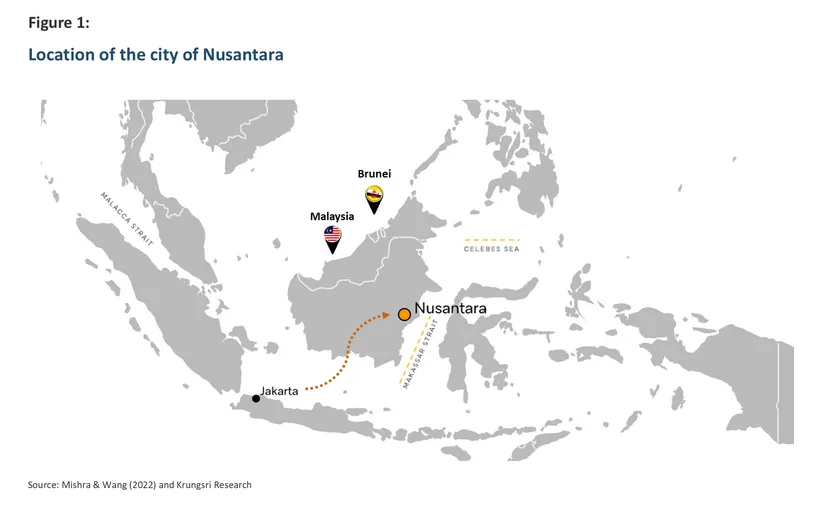
Developing new trade routes: IKN is located in East Kalimantan, which borders the Malaysian states of Sarawak and Sabah to the north, creating an opportunity for Indonesia to expand trade connectivity and develop new maritime routes between Indonesia and its neighbors (Figure 1).
Nusantara Development Plan
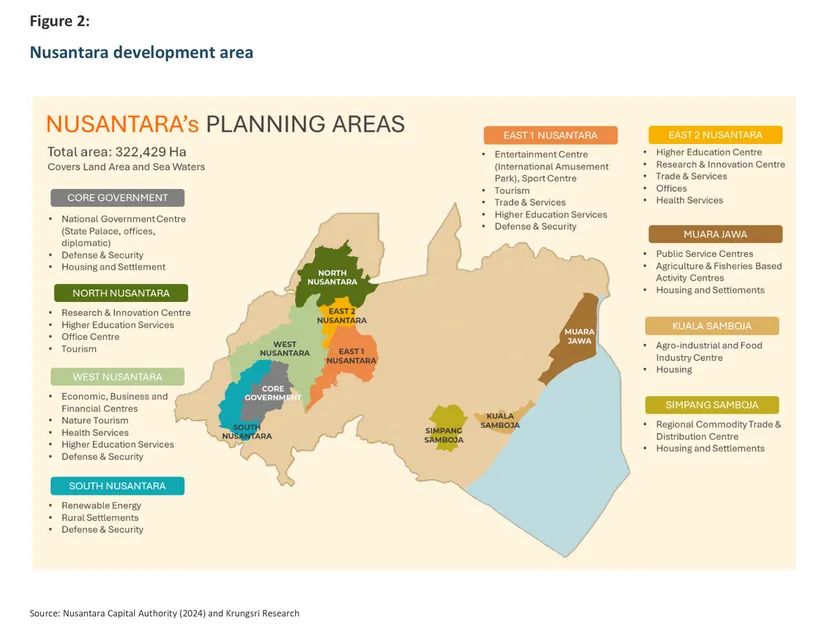
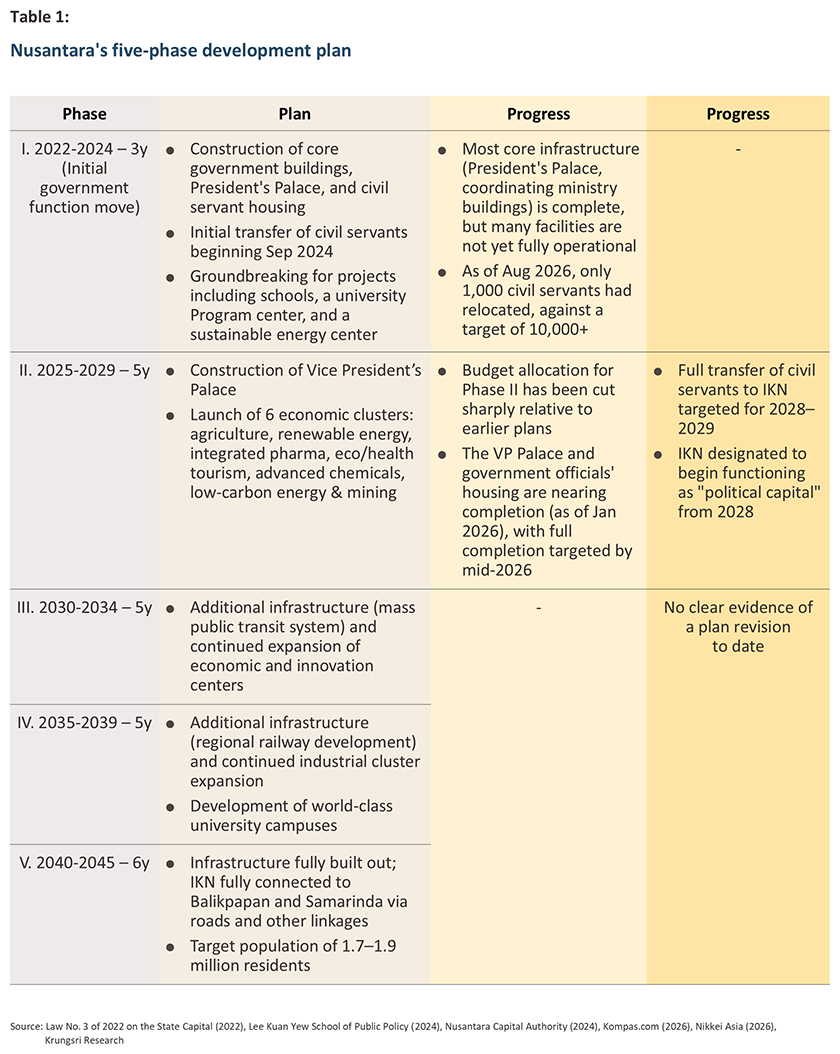
The IKN master plan divides development into five phases spanning 2022 to 2045. The Indonesian government estimates total development costs of IDR 523 trillion (approximately USD 35 billion), equivalent to around 4% of Indonesia’s GDP. The government aims to limit public funding to no more than 20% of total investment, with the remainder to be financed primarily by the private sector, including both domestic and foreign investors. IKN's development area covers both land and sea, with the land area comprising the capital zone, the core government center, and industrial areas (Figure 2).
To attract domestic and foreign private investment, the Indonesian government has introduced regulations aimed at facilitating investment and providing incentives for investors in IKN. These include tax incentives in the form of deductions and exemptions, streamlined business licensing procedures, long-term land tenure rights, and relaxed restrictions on foreign business activities, among others.
Recent Developments in Nusantara
Progress on IKN's development has fallen behind schedule. The Nusantara Capital City Authority (OIKN)2/ reported that, in early 2024, construction of the government core zone under Phase 1 of the development plan3/ was only 70–80% complete. Meanwhile, the planned relocation of civil servants and government agencies to IKN has been postponed. The relocation was originally scheduled to begin in September 2024 and be completed by 2027, but has recently been pushed back to 2028–2029 due to delays in the construction of core infrastructure. Furthermore, in May 2025, the government changed how IKN is referred to in an official document, from the “National Capital” to the “Political Capital4/,” raising questions over whether the project is being scaled back from its original ambitions and given lower priority.
Although the government and OIKN maintain that IKN will be ready to serve as the “Political Capital” by 2028, evidence gathered by academics and investors during on-site visits, along with findings from several reports, paints a different picture. While core government infrastructure has made substantial progress, essential facilities for residential living—such as healthcare facilities, educational institutions, and critical basic utilities— remain largely unready or have yet to begin construction. As a result, IKN remains insufficiently prepared to accommodate the relocation of residents and civil servants in the near term (Ellis, 2024; Nielson, 2025).
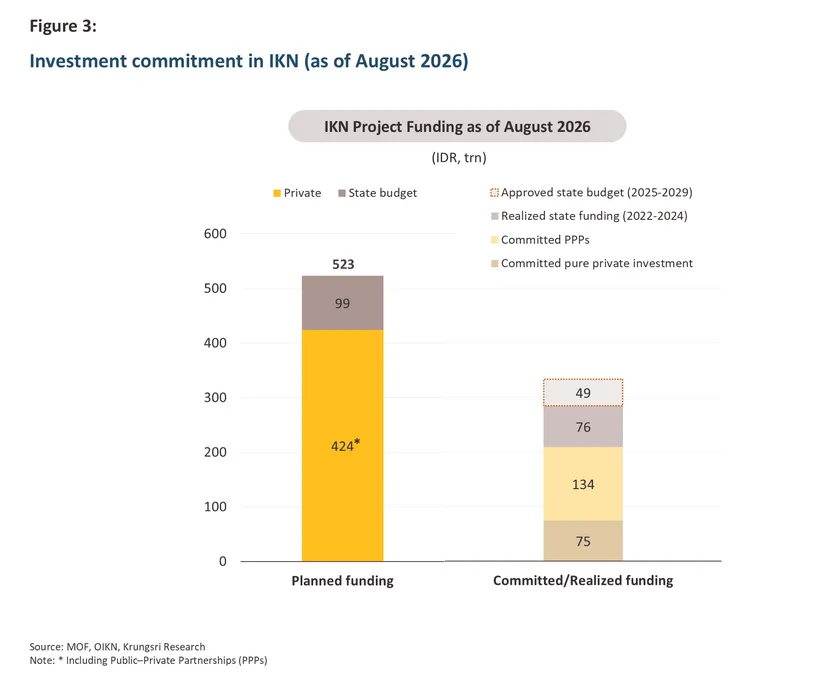
On the funding front, attracting private investment remains far short of target. As of August 2026, OIKN reported total investment commitments from the private sector combined with realized government funding of approximately IDR 296 trillion (roughly USD16.7 billion), or 56.6% of the total investment estimated to be required for the project's development. Looking at the composition of these commitments, the majority are Public-Private Partnerships (PPPs), while pure private investment accounts for only 25% of total committed value and just 14% of the government’s target for private-sector investment, which was set at around IDR 424 trillion (Figure 3).
At the same time, the fiscal burden associated with the project has continued to increase. During Phase 1 of development (2022–2024), the government disbursed IDR 75.8 trillion, or about 76% of the state's IDR 99 trillion budget envelope set for the entire 22-year project. For Phase 2 (2025–2029), the government approved an additional IDR 48.8 trillion in funding. As a result, total disbursements combined with allocated funding have already exceeded the original public funding framework by more than 26%. This situation highlights IKN’s heavy reliance on state budget and raises concerns over both fiscal sustainability and the government’s ability to attract further private investment going forward.
Why is Nusantara’s Development Delayed?
The key obstacles and operational challenges that have caused IKN development to fall behind the master plan can be broadly divided into two areas:
funding gap and local challenges, as follows:
Funding Gap
The funding gap is a key constraint to IKN development. Efforts to attract private and foreign investment have progressed slowly, while actual investments remain well below the target. At the same time, public financing faces constraints from narrowing
fiscal space, limiting the government's ability to shoulder a larger share of the project's funding burden. The causes include:
First, the lack of clarity surrounding the development plan. Although the IKN project has a broad-based vision covering multiple dimensions, its intended outcomes remain insufficiently defined. Moreover, the rushed preparation of the master plan and limited scope of the feasibility study have left the project lacking
commercial clarity, particularly in terms of target industries, potential returns, and locations or activities that are commercially viable for investment. While a large number of investors showed early interest and visited the site, this lack of clarity has undermined confidence, limiting the extent to which early interest and investment commitments have translated into actual investment.
Second, project management and regulatory challenges. Indonesia’s transition from the Jokowi administration to that of Prabowo Subianto in October 2024 has left many policy areas lacking continuity. In addition, the Prabowo administration has placed lower priority on the IKN project, adding greater uncertainty to budget allocations for the project's continued development. Meanwhile, the government has revised regulations that had previously provided incentives for long-term investment, further weakening confidence and weighing on private investors' decisions.
Overall, the factors underlying the funding constraints are closely linked to the role of the government.
The future development of IKN is therefore likely to depend heavily on the government’s policy direction and commitment to the project.
Local Challenges
These challenges can be broadly divided into two areas:
(1) environmental issues. While most of IKN's core area was formerly commercial plantation forest, the project sits within a broader landscape of high-biodiversity tropical rainforest — including orangutan habitat and the mangrove forests of Balikpapan Bay — which has drawn opposition from environmental conservation groups since the project's inception. Although the Jokowi administration insisted the new capital would be built alongside natural-resource conservation, an environmental impact assessment process that was insufficiently thorough and lacked transparency left the project exposed to natural hazards that had not been properly assessed, such as water scarcity, heat, and wildfires. These challenges provide a lesson similar to Brazil’s capital relocation to Brasília
5/.
(2) Human-resource issues arise from two major groups. The first comprises local residents who must adapt to the transformation of the area into an urban environment. The second comprises civil servants designated to relocate from Jakarta, many of whom remain reluctant to leave their families and established communities behind and move to a new capital where key infrastructure is still incomplete.
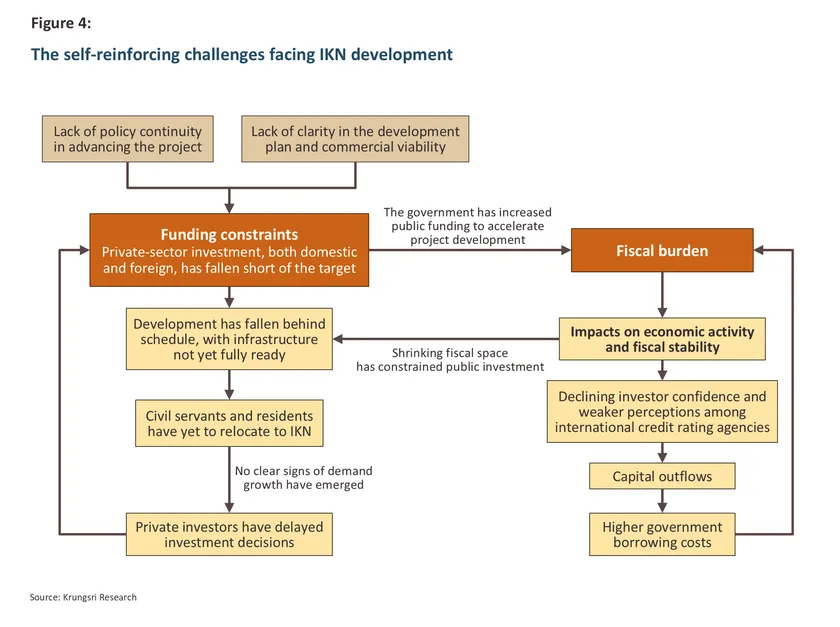
In summary, IKN development face challenges related to both funding and the local operating environment. These constraints are interconnected and reinforce one another. Specifically, lower-than-planned private investment delays infrastructure construction, which in turn prevents civil servants and the population from relocating to IKN. At the same time, the lack of visible growth in economic activity has weakened investor confidence and discouraged further private investment, which in turn further delays infrastructure development — creating a self-reinforcing cycle of slow investment and development.
Against this backdrop, this has led to proposals for the government to accelerate its own investment to advance IKN development and break this self-reinforcing cycle. However, this approach would run counter to IKN’s original development model and to the Prabowo administration’s policy of relying primarily on private-sector financing. Moreover, it faces constraints from
narrowing fiscal space, following the Prabowo administration’s expansion of government spending on other populist programs aimed at boosting short-term growth.
These challenges raise the question of whether, and how, Indonesia will continue to push forward this capital relocation going forward.
Nusantara’s Future Direction and Economic Implications
Direction of IKN's development
IKN’s development is expected to continue, given the project's legal status
6/, it cannot simply be removed from the country’s long-term development plans. However, given construction delays, funding and project management constraints, and the changing political environment under the Prabowo administration,
the future development trajectory is likely to diverge from the original plan both in terms of the project’s role and scale and its development timeline, as follows:
-
Project role and scale: Policies under the Prabowo administration signal that IKN’s role has been scaled back from a “national capital” to an “political capital.” In addition, the budget for IKN's Phase 2 development (2025–2029)7/ has also been cut sharply below the Phase 1 budget (2022–2024), and the budget actually allocated for 2025–2027 has still fallen short of half of what OIKN requested in each of those years. Furthermore, the Prabowo administration has revised regulations that once incentivized long-term investment — most notably, reducing the maximum land-use tenure period for foreign investors in IKN to 95 years, from 190 years previously8/. These decisions underscore that the current Indonesian government has reduced the priority given to IKN development, both in terms of resource allocation and investment-supportive regulations. Going forward, IKN is likely to develop as a “secondary capital” (Yusof Ishak Institute, 2025), serving a largely symbolic administrative role rather than functioning as a national capital with a significant role in economic activity.
-
Development timeline: IKN development has clearly fallen behind the timeline set out in the master plan. Even as the project has now entered Phase 2, some key infrastructure carried over from Phase 1 remains incomplete, while ongoing construction has also progressed more slowly than during the initial stages of the project.
Economic Implications
-
Domestic stability implications
The government’s planned budget allocation for IKN investment is relatively small and appears unlikely to have a significant impact on public finances in short term, particularly given the fiscal deficit ceiling of no more than 3% of GDP a year, state budget data as of October 2025. However, it indicates that public funding commitments have already exceeded the original plan. Meanwhile, constraints on attracting private investment and continued project delays suggest that IKN is likely to remain heavily dependent on public funding or investment by state-owned enterprises in the years ahead.
The project therefore faces the risk of becoming a larger long-term fiscal burden than the government initially assessed and targeted.
Although Indonesia’s public debt remains at a manageable level
9/,
additional budget allocations for IKN going forward could place further pressure on Indonesia’s credibility in the eyes of investors and international credit rating agencies, particularly amid the confidence crisis that emerged in mid-2026
10/. Concerns over fiscal discipline and policy credibility have already contributed to significant foreign capital outflows.
If the government fails to manage investment in large-scale projects while restoring policy credibility effectively, there is a risk that these effects could spill over into the investment climate surrounding IKN.
-
Macroeconomic implications
The Jokowi administration expected IKN to play an important role in driving economic growth, though the project’s current progress and development direction suggest that its positive effects on macroeconomic factors—including employment, consumption, and investment—remain limited. While some local economic activity and employment have emerged, they remain concentrated in construction sites.
Such activities are insufficient to generate a meaningful impact unless the government can extent the project into higher value-added economic activities over the longer term.
-
Impact on employment and consumption. To date, Phases 1–2 of the IKN development has not yet generated significant employment or consumption. That said, if the government can develop advanced industrial zones in line with the targets set for Phase 3, and succeed in attracting investment in technology-intensive industries or other high-value economic activity, these industries could potentially generate long-term employment and greater demand for high-skilled labors, thereby supporting broader economic activity and consumption.
-
Impact on investment. Investment in IKN continues to face several constraints. If the government is unable to build investor confidence or offer sufficient incentives, private-sector investment may expand only to a limited extent. Moreover, if the government decides to increase the share of public funding allocated to IKN development, this could divert fiscal resources away from other public projects that may provide greater support to the domestic economy. At the same time, should the government resort to additional borrowing to finance higher spending, this could, in theory, crowd out private investment (crowding-out effect), since government borrowing may absorb liquidity from the financial system and push up private-sector borrowing costs.
Krungsri Research View
The development of Nusantara (IKN) has not yet become Indonesia’s economic burden, but it remains far from becoming the economic growth driver envisioned by Jokowi. Actual outcomes have fallen short of nearly every aspect — from private investment remaining below target, to public funding exceeding the planned framework, and the project receiving lower priority under the current administration. These constraints reflect the risk that IKN could ultimately impose a greater fiscal burden than economic benefits it generates if the government fails to address these underlying constraints and build sufficient momentum from the private sector.
Breaking the self-reinforcing cycle of challenges and turning IKN into a driver of economic growth
will depend on the government's ability to manage public investment while restoring confidence among domestic and foreign private investors, in order to narrow the funding gap. If the government can provide greater clarity and policy continuity in pushing forward key infrastructure in IKN, while addressing local challenges in a more prudent and transparent manner,
IKN could still stand a chance of succeeding as a "Political Capital" and generating economic activity that supports economic growth, even if it falls short of the full scale originally envisioned.
Despite the project’s lower priority, investment opportunities remain, particularly in activities aligned with IKN’s vision of becoming a green city of the future. Under the Smart Forest City concept, the government continues to pursue the integration of modern infrastructure with environmental and energy sustainability, opening opportunities for investment across several areas, such as renewable energy infrastructure and smart-city solutions. Nevertheless, investors should assess investment potential alongside IKN’s actual development progress, while prioritizing projects in which the government participates in risk-sharing — such as
Public-Private Partnership (PPP) projects, to reduce exposure to uncertain demand growth within the area.
In summary, while IKN has not become a
“ghost city,” as many had feared, it remains far from becoming the economic growth engine originally envisioned. Whether the project can regain momentum amid the confidence crisis that has built up this year
will therefore depend more on the Indonesian government’s ability to address its underlying challenges and restore investor confidence, not on expressions of policy commitments alone.
References
Abdullah, F. (2026, July 6). Indonesian Parliament Approves $334 Million for New Capital Nusantara in 2027. Retrieved from jakartaglobe.id.
Asmaaysi, A. (2025, September 15). Banggar Tolak Tambahan Anggaran Otorita Rp14,92 Triliun, Proyek IKN Terancam? Retrieved from Bisnis.com.
Chia, G., & Lo, E. (2025, July 17). ASEAN Ascends – Nusantara: Indonesia’s Future Capital and its Business Implications. Retrieved from Hong Kong Trade Development Council.
CNN Indonesia. (2025, July 8). OIKN Minta Tambahan Anggaran Rp16,13 T di 2026. Retrieved from www.cnnindonesia.com.
Damayani, L. (2025, August 12). IKN and Sustainability: Measuring Progress and Consistency.
Ellis, A. (2024, September 19). My Visit to Nusantara Indonesia's new capital city in the making. Retrieved from Archipelago Notes: https://archipelago.substack.com/p/my-visit-to-nusantara
Hudalah, D. (2025). Planning Indonesia’s New Capital City Behind Nusantara. Oxon: Routledge.
Indonesia Business Post. (2024, January 29). Nusantara authority targets Rp 100 trillion investments in 2024. Retrieved from Indonesia Business Post.
Indonesia’s delayed new capital risks becoming white elephant. (2025, September 7). Retrieved from The Straits times.
Isaac, J. (2025, August 18). Indonesia allocates Rp6.26 trillion for IKN in 2026, down from previous years. Retrieved from Indonesia Business Post.
ISEAS Yusof Ishak Institute. (2023). The road to Nusantara Process, Challenges, and Opportunities. Singapore: ISEAS Publishing.
Lundgreen's Investor Insights. (2025, February 10). Nusantara: Site of Indonesia’s future economic development? Retrieved from lundgreens.com.
Makarim & Taira S. (2023, March). Ibu Kota Nusantara (IKN). Retrieved from Makarim & Taira S.: https://www.makarim.com%2Fnews%2Foverview-of-private-investment-to-indonesia-s-new-capital-city-ibu-kota-nusantara-ikn%2Fpdf&usg=AOvVa
Mark, E., & Masron, I. (2025, December 22). Indonesia’s New Capital Project Undermines Indigenous Cultures. Retrieved from ISEAS Yusof Ishak Institute.
Mishra, R., & Wang, P. M. (2022, October 31). From Jakarta to Nusantara: making sense of Indonesia’s capital shift. Retrieved from Lowy Institute.
Moeller, A. K. (2025, October 23). Nusantara: the city that never was. Retrieved from New Mandala.
Negara, S., & Rebecca, N. (2024, August 2). The Nusantara Project in Progress: Risks and Challenges. Retrieved from ISEAS Yusof Ishak Institute.
Nielson, M. (2025, October 29). Indonesia’s new capital, Nusantara, in danger of becoming a ‘ghost city’. Retrieved from The Guardian.
Nugroho, Y., & Adrianto, D. (2022, July 7). “The Nusantara Project: Prospects and Challenges”. Retrieved from ISEAS Yusof Ishak Institute.
Nusantara Capital Authority. (2024, January 30). NCA: Nusantara Development on Target, Total Investment Reaches IDR 47.5 Trillion. Retrieved from https://ikn.go.id/.
Nusantara Capital Authority. (2025). Nusantara Indonesia’s Smart and Sustainable Forest City. Kalimantan.
Nusantara Capital Authority. (n.d.). Achievement Report 2023 of Nusantara Capital Authority. East Kalimantan.
Nusantara Legal Partnership. (2022, April 15). Nusantara Legal Partnership. Retrieved from https://nusantara
legal.com/: https://nusantaralegal.com/indonesia-new-capital-nusantara-key-points-of-law-no-3-of-2022-on-the-state-capital/
Peacock, A. (2025, December 12). Indonesia's capital Indonesia's new capital city Nusantara downgraded to political capital. Retrieved from www.dezeen.com.
Prabowo, A., & Pepinsky, T. (2026). Indonesia’s New Capital City: Public Funding and Public Support. Bulletin of Indonesian Economic Studies, 62(2), 215-244.
Pratiwi, A. (2026, January 3). IKN 2026 Development Gets Rp6tn State Budget Allocation. Retrieved from TEMPO.CO English.
Rahayu, R. (2025, April 20). IKN Development Secures Rp13.5 Trillion Budget, Authority Ensures Project Completion. Retrieved from TEMPO.CO English.
Redaksi, T. (2024, Jun 11). Otorita IKN Usulkan Tambahan Anggaran Rp 29,8 Triliun di Tahun 2025. Retrieved from beritakota.id.
Rinaldi, R. (2025, October 31). Nusantara Capital authority secures Rp225 trillion in investments. Retrieved from Indonesia Business Post.
Ritonga, M. (2026, June 11). To Meet the 2028 Target, the IKN Authority Requests an Additional Budget of IDR 15.5 Trillion. Retrieved from www.kompas.id.
Silfia, I. (2023, September 20). IKN budget realization at Rp6.4 trillion as of Aug: finance minister. Retrieved from ANTARA News.
Singapore, L. K. (2024). The Long Road to Nusantara – Shifting Indonesia’s Capital.
SSEK Law Firm. (2023, March 27). Retrieved from https://ssek.com/blog/indonesias-capital-idea-new-regulation-encourages-investment-in-nusantara/
Sugihartono, S. (2024, August 20). Nusantara Capital City Mega Project in Indonesia: Progress and Public Skepticism. Retrieved from Modern Diplomacy.
Sullivan, A. (2024, August 15). Will Indonesia's new capital city ever be finished? Retrieved from www.dw.com.
Suprayogi, W., & Merapi, H. (2024, June 10). OIKN minta tambahan anggaran Rp29,8 triliun untuk pagu indikatif tahun 2025. Retrieved from www.harianmerapi.com.
Taylor, C. (2026, July 14). Indonesia’s Capital Problems. Retrieved from thediplomat.com.
The Jakarta Post. (2026, August 21). IKN earmarks US$298mil for judicial buildings. Retrieved from Thestar.com.
The Republic of Indonesia. (2022, February 15). Law of the Republic of Indonesia Number 3 of 2022 on National Capital.
1/ For example, a master plan to relocate the capital to Palangka Raya, under the presidency of Sukarno, which was later abandoned; Palangka Raya instead became the capital of Central Kalimantan province, owing to technical and economic constraints.
2/ The Nusantara Capital City Authority (Otorita Ibu Kota Nusantara: OIKN) is a special ministerial-level body established to manage, plan, and develop Nusantara as Indonesia's new capital.
3/ Phase 1 of the development plan (2022–2024) covers construction of core infrastructure, including the Presidential Palace, government office buildings, civil servant housing, schools, hospitals, and shopping centers, as well as the initial relocation of government administration.
4/ A "National Capital" generally refers to a city with official legal status as the center of the state, encompassing political, administrative, economic, and international-relations functions. A change in such status therefore requires a clear legal process. "Political Capital," by contrast, does not appear as a defined term under Indonesia's capital-city law and has no official definition. It may be interpreted as the seat of the political institutions — the executive, legislature, and judiciary. Use of the term is therefore contested, as it may not be equivalent to a full relocation of the capital, and reflects a scaled-back role for the new city centered on administration rather than serving as the state's center across all dimension.
5/ Brazil relocated its capital from Rio de Janeiro to Brasília in 1960. The most severe environmental impacts were caused not by the new city itself, but rather from the transportation networks constructed to connect Brasília with other regions. These networks effectively facilitated the subsequent encroachment into the Amazon rainforest over the following decades.
6/ Law No. 3 of 2022 on the State Capital, issued 15 February 2022, sets out the establishment of the capital, the development plan, territorial boundaries, the governance structure, urban planning and land-rights allocation, financing and state-budget management, and the transfer of capital status.
7/ IDR 48.8 trillion (approximately USD 2.89 billion), equivalent to around 60% of the budget allocated for Phase 1 of IKN development.
8/ The Constitutional Court ruling issued of November 13, 2025, took immediate effect.
9/ Indonesia’s public debt stood at 39.9% of GDP as of end-June 2025.
10/ See also From ASEAN Darling to Investor Concern: Indonesia at a Crossroad