Executive Summary
Indonesia's economic growth has been driven primarily by consumption from middle-income households. However, this segment is becoming increasingly vulnerable, as reflected in the continued decline in the share of the middle class in the total population. This trend is driven by weaknesses in public policies, structural challenges in the labor market, an influx of low-cost imports from China, and rising living costs due to higher energy prices stemming from the conflict in the Middle East.
These pressures are likely to persist, increasing the risk of middle-income households slipping into lower-income groups. This could weaken domestic purchasing power and become a key downside risk to Indonesia's economic growth outlook in the years ahead.
Introduction
Indonesia's economy is driven primarily by domestic demand, with private consumption accounting for 55.8 percent of gross domestic product (GDP) in the first quarter of 2026, supported by a large working-age population with a low average age. This consumption-led growth relies on middle-income households as a key source of purchasing power.
At present, however, this growth base is increasingly showing signs of fragility, as reflected in the continuous decline in the middle class as a share of the total population since 2019, consistent with weakening real wages. This is compounded by a labor structure composed mostly of low-skilled and semi-skilled workers1/ , which has left Indonesia's labor-intensive industries particularly vulnerable to the influx of low-cost imports from China. Moreover, the populist policies pursued under President Prabowo's new government have left middle-income households to shoulder the burden of adjustment on their own, while the disruption of energy supply resulting from conflict in the Middle East has further aggravated these strains. These factors have left private consumption, the principal engine driving the economy, facing mounting challenges.
This article analyses three key issues. First, the declining trend in the share and number of the middle class and the deterioration in labor-market quality in Indonesia. Second, the factors underlying this contraction, classified into domestic structural factors and external factors. Third, an assessment of the implications for private consumption, which has long been the principal engine driving Indonesia's economic growth.
Signs of the Problem
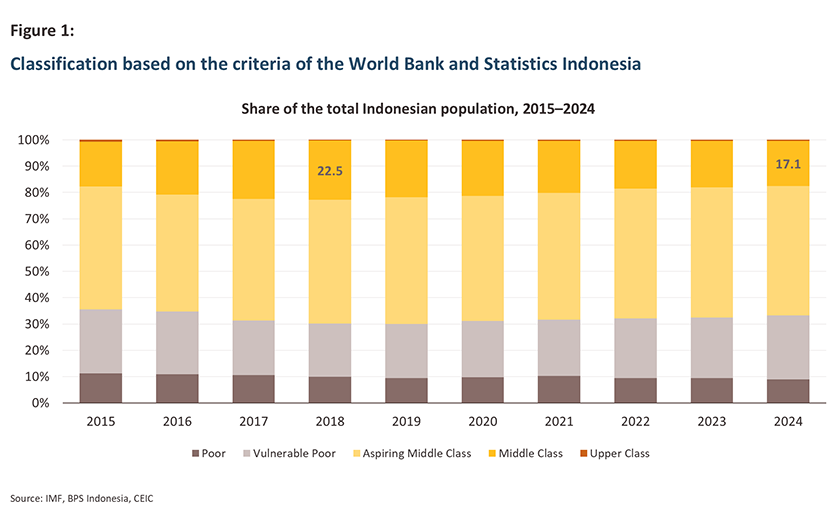
Indonesia's middle-class2/ has been declining steadily since 2019 in both number and share. The middle-class population in Indonesia fell from 59.5 million in 2018 to 47.9 million in 2024. Over the same period, the middle class as a share of the total population declined from a peak of 22.5 percent in 2018 to just 17.1 percent in 2024. The share of the aspiring middle class and of the vulnerable poor near the poverty line, however, has tended to rise (Figure 1). These data indicate that the contraction of the middle-class stems from some middle-class households moving down into lower-income groups rather than moving up into higher-income groups.
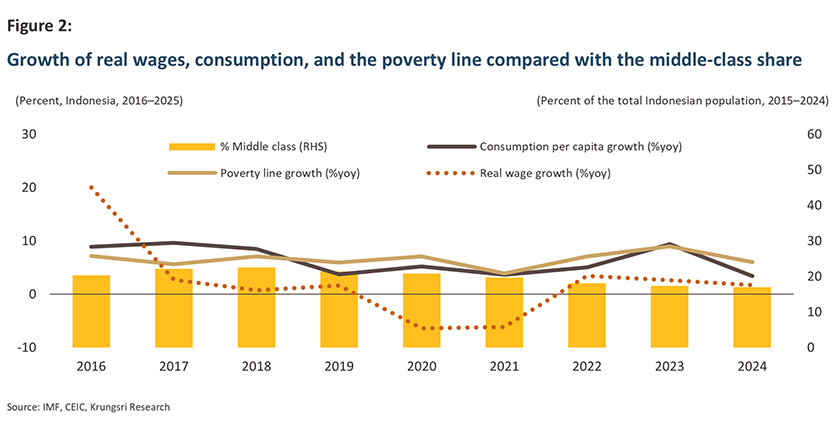
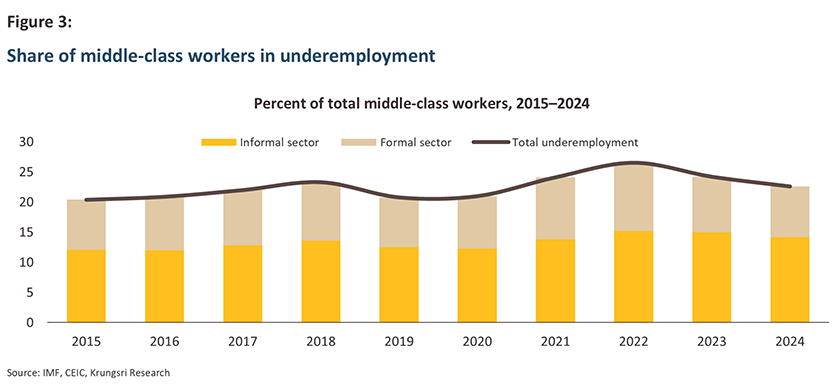
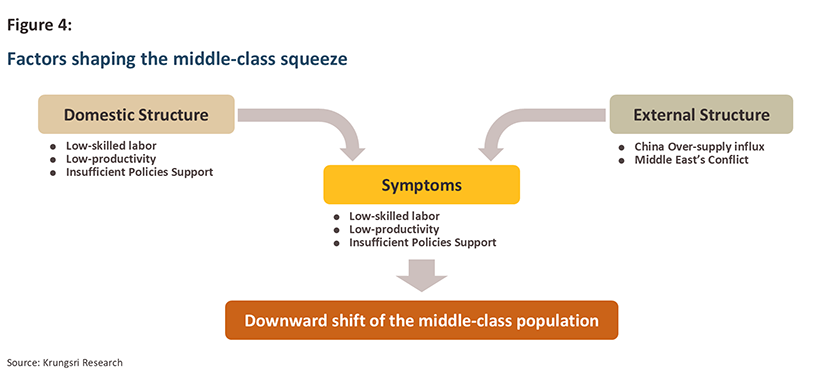
This contraction of the middle class has occurred alongside a slowdown in real wages and a deterioration in labor-market quality (Figures 2 and 3). The share of workers in underemployment rose markedly between 2019 and 2022, indicating that although many workers were employed, they could not work full time or fully utilize their potential. During 2022 to 2024, the share of underemployed workers began to ease somewhat, but the recovery was largely concentrated among formal-sector workers and remained insufficient to raise overall labor-market quality. In addition, informal employment continued to expand, rising from 74.08 million in 2019 to 86.58 million in 2025 (Mediana, 2025), indicating that many workers still depend on low-quality3/ and insecure work. Taken together, the overall picture and trends set out above show that a substantial number of middle-income households are moving out of formal employment into informal work or underemployment, so that these households will ultimately shift down into lower-income groups. The causes of this contraction of the middle class can be classified into two main groups, namely domestic structural problems and external factors (Figure 4).
Causes
The contraction of Indonesia's middle-class stems from both domestic structural factors and external pressures, with the fragility of the labor market being a key factor that has made the Indonesian economy increasingly sensitive to external shocks. The details are as follows.
1.Domestic structural weaknesses and insufficient support policies
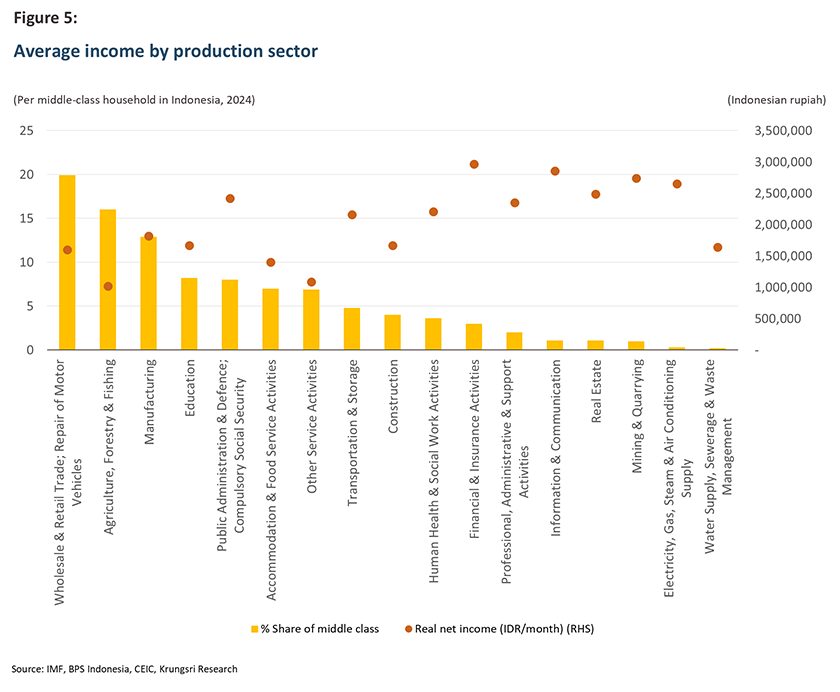
Indonesia's workforce is concentrated in blue-collar occupations4/ , which are mostly low-skilled, with more than half of middle-class workers employed in such occupations (Tresnatri et al., 2025). This occupational structure limits income levels, wage growth, and the opportunity to move up into higher-income groups (Figure 5), leaving incomes unable to keep pace with the continuously rising cost of living (Figure 2). Because the root of this problem lies in structural weakness, it must be addressed through support policies that are adequate in both quantity and quality, such as upgrading labor quality, strengthening the social safety net, and enhancing investment attractiveness.
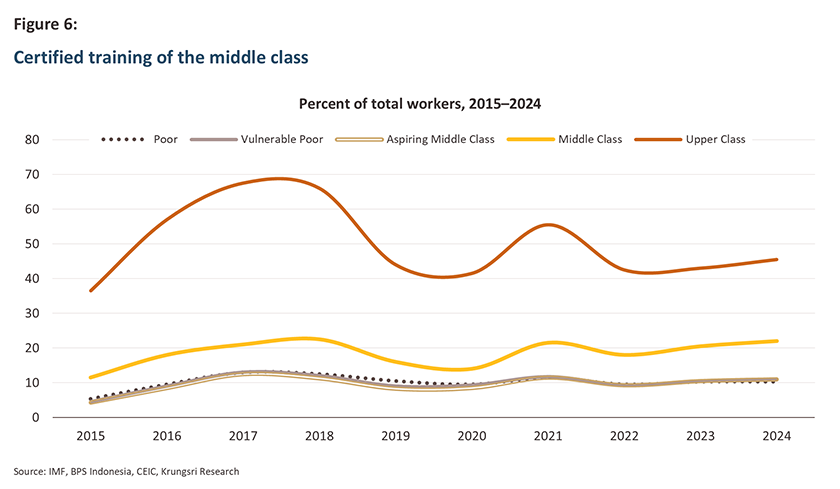
To date, however, policies aimed at addressing the structural problems of Indonesia's labor sector have remained insufficient. The share of the middle class with access to certified training remains clearly lower than that of high-income households (Figure 6), reflecting inequality in access to skills-development opportunities. At the same time, the overall workforce remains relatively low-skilled and, combined with infrastructure constraints, this leaves Indonesia's competitiveness lagging behind other countries in the region5/, and prevents Indonesia from attracting high value-added industries and generating sufficient demand for high-skilled labor. Furthermore, the government shows little sign of accelerating efforts to raise domestic labor quality to match that of other countries. Such inadequate development policies further undermine Indonesia's future competitiveness (OECD, 2026; World Bank, 2020).
Beyond these structural weaknesses, President Prabowo's more recent policies have done little to support the middle class. Although many measures were designed to address the short-term economic slowdown, the government's choice to rely primarily on such measures reflects a weakness in a policymaking process that prioritizes political popularity over long-term structural reform. Specifically, the government has devoted substantial budget resources to assisting low-income households, which form the country's largest voter base, such as the free-meal program aimed mainly at the poor (Ludher, 2024).
In addition, the International NGO Forum on Indonesian Development (INFID)6/ reports that the Prabowo government diverted education budget to support other programs, causing the share of the education budget in fiscal year 2026 to fall to approximately 14.2 percent of the state budget (APBN)7/ , below the minimum threshold of 20 percent set out in Article 31, paragraph 4 of the 1945 Constitution (Singarimbun, 2026). This reduction raises concern that the government will be unable to make tangible improvements in education quality, which is a root of the structural problem, particularly that of low-skilled labor.
2. External factors
Beyond domestic weaknesses, external pressures have further deepened the fragility of Indonesia's middle class. The most prominent factor is the flood of low-cost imports from China that have surged into the Indonesian market since 2023 (Kelly et al., 2025), severely affecting domestic manufacturing, particularly the textile and garment industry (Heijmans, 2025), which is a major source of employment for low-skilled, lower-income middle-class workers (Figure 5). This pressure has been one factor accelerating the successive closure of textile factories and continuous layoffs. In the first half of 2024, the textile industry laid off around 14,000 workers, while the bankruptcy of Sritex8/, a major producer, led to the layoff of a further 10,000 or so workers in 2025. Moreover, as of June 2026, around 50,000 additional workers are at risk of being laid off. These figures cover only formal employment and may therefore understate the actual impact (Cahyoputra, 2024; SCMP's Asia Desk, 2025; Indonesia-Investments, 2026).
These textile-factory closures reflect the premature deindustrialization that Indonesia has faced continuously, which has led to a broad decline in formal manufacturing employment, particularly in labor-intensive industries that were once a stable source of jobs and a principal channel for climbing into the middle class (Rehman, 2026). Many laid-off workers have therefore had to turn to informal employment, which not only pays less but also lacks social protection and offers uncertain income, thereby undermining both the level and the stability of household income and further accelerating the contraction of Indonesia's middle class.
Considering domestic factors and external pressures together, these factors combine to form a self-reinforcing cycle. Specifically, insufficient upskilling and reskilling leaves these workers unable to move into higher value-added sectors when they face competition from imports, and once laid off they must turn to low-paid and uncertain informal employment. Households therefore lack the means to invest in the education and skills development of the next generation. At the same time, the contraction of the middle class erodes the tax base and limits the government's fiscal space, giving the government an incentive to choose short-term assistance measures rather than investment in structural reform, as reflected in the reduced share of the education budget. This cycle thus locks these workers into their existing skill level and passes vulnerability forward when the next economic shock occurs.
3. Assessing the implications for private consumption
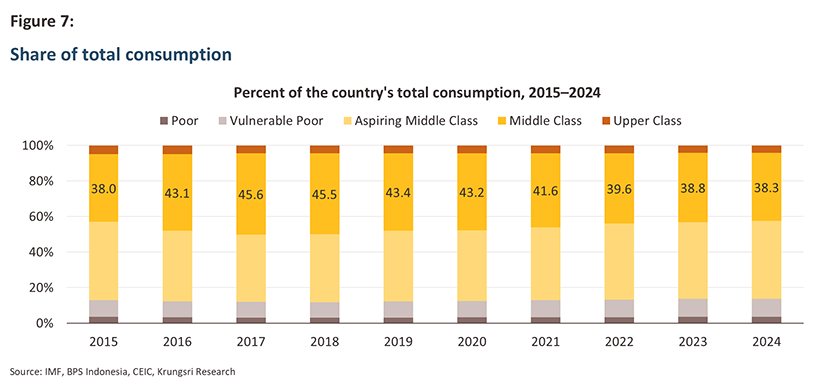
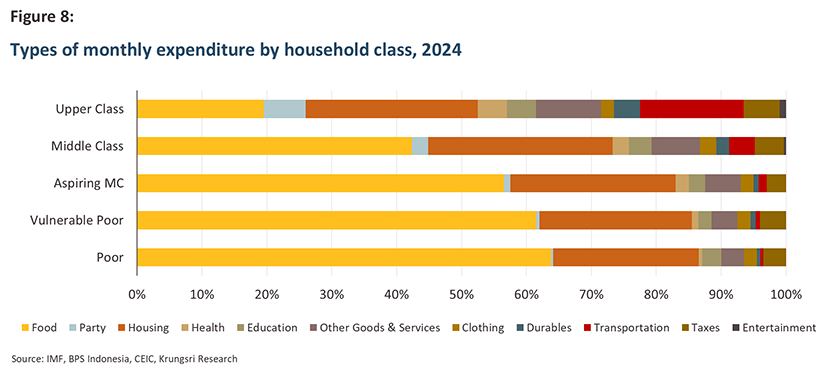
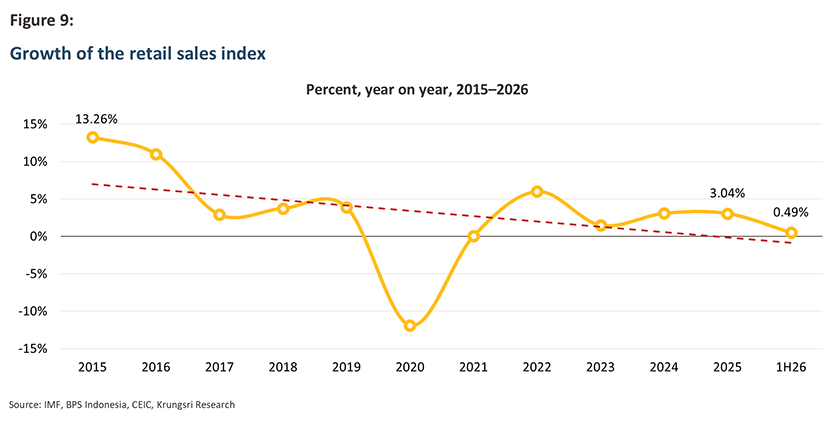
Indonesia's middle-income households have long played a significant role in total domestic consumption, but that role has begun to decline steadily. In 2024, this group's spending accounted for 38.3 percent of domestic consumption, a clear decline from 45.4 percent in 2019 (Figure 7). This decline reflects both the falling number of households in this group and their weakening purchasing power. Nevertheless, middle-income households still account for about one-third of the country's overall spending, and with private consumption representing a little over half of GDP, the continuous contraction of the middle class noted above is leading to a structural change in the consumption of households formerly classified as middle-income. The share of spending on high value-added goods and services has been reduced and replaced by necessities and low-cost goods (Figure 8), indicating weakening household purchasing power. This is therefore a direct risk to private consumption and to the country's economy as a whole. This pressure is reflected in the growth rate of the retail sales index, which slowed from 13.3 percent in 2015 to just 3.0 percent in 2025 and to only 0.5 percent in the first half of 2026 (Figure 9).
Krungsri Research View
Indonesia's middle class is under pressure from policymaking that has yet to raise labor quality effectively, leaving these workers struggling to adapt as domestic industries face competition from low-cost Chinese imports that have accumulated steadily since 2023. At the same time, the middle class also faces pressure through financial channels arising from weakening confidence in the quality of the government's policy9/. In the first half of 2026, this eroding confidence, together with pressure from global financial-market conditions and higher oil prices stemming from conflict in the Middle East, accelerated capital outflows and caused the rupiah to depreciate by more than 8 percent since the start of the year. The Bank of Indonesia therefore had to raise its policy rate by a total of 100 bps during May and June 2026, to 5.75 percent per year from 4.75 percent at the beginning of the year, in order to maintain currency stability and contain inflation. Such monetary tightening further increases borrowing costs for middle-income households, since these households rely primarily on credit to purchase housing and vehicles.
In addition, although foreign direct investment (FDI) is still expected to expand in the first half of 2026, its growth rate has slowed markedly, and most of the funds are concentrated in primary mineral-processing industries and the telecommunications sector, which are more capital-intensive than labor-intensive and therefore cannot absorb the low-skilled workers laid off from traditional manufacturing. At the same time, higher financing costs following the interest-rate increase and the rise in risk premiums will constrain domestic businesses' investment in expanding production capacity, and if investor confidence does not recover in the near term, it may affect future FDI inflows. This would undermine the business investment climate and limit the expansion of the manufacturing sector, further reducing the prospects for stable employment among middle-income households.
The structural and cyclical pressures described above are likely to persist going forward, and as private consumption remains the principal engine of the Indonesian economy, the downward shift of the middle-class population into lower-income groups may become a significant risk to the country's economic growth outlook in the period ahead, both through directly weaker purchasing power and through a narrower tax base that will further limit fiscal space for investment to address structural problems, reinforcing the self-reinforcing cycle noted above.
References
Tresnatri, F. A., Dachlan, A. N., Wibowo, G. C., & Pasha, R. (2025). Stuck in the middle with you? An assessment of income dynamics in Indonesia (IMF Working Paper No. 2025/265). International Monetary Fund. https://doi.org/10.5089/9798229032377.001
Mediana. (2025). Pekerja Indonesia bergantung pada pekerjaan informal [Indonesian workers depend on informal work]. Kompas. https://www.kompas.id/artikel/en-pekerja-indonesia-bergantung-pada-pekerjaan-informal
Cahyoputra, L. A. L. (2024, June 13). Textile industry crisis: Factory closures and nearly 14,000 layoffs due to imported goods. Jakarta Globe. https://jakartaglobe.id/business/textile-industry-crisis-factory-closures-and-nearly-14000-layoffs-due-to-imported-goods
South China Morning Post. (2025). Over 10,000 Indonesians lose their jobs in Sritex collapse. https://www.scmp.com/week-asia/economics/article/3300816/over-10000-indonesians-lose-their-jobs-sritex-collapse
Indonesia Investments. (2026). Indonesia's 50,000-worker warning: The structural pressures driving the latest layoffs. https://www.indonesia-investments.com/business/business-columns/indonesia-s-50-000-worker-warning-the- structural-pressures-driving-the-latest-layoffs/item9943
OECD. (2026). Foundations for growth and competitiveness 2026. OECD Publishing. https://www.oecd.org/en/publications/2026/04/foundations-for-growth-and-competitiveness-2026_f68a156b.html
World Bank. (2020, June 22). Indonesia public expenditure review: Spending for better results. https://www.worldbank.org/in/country/indonesia/publication/indonesia-public-expenditure-review1
Susanti, D., Priebe, J., & Bah, A. (2020, February 4). The hard truth: Challenges of primary education in rural and remote Indonesia. World Bank Blogs (East Asia & Pacific on the Rise). https://blogs.worldbank.org/en/eastasiapacific/hard-truth-challenges-primary-education-rural-and-remote-indonesia
Shanty, M. V., Mahadtir, M., Awaluddin, A., Natalia, D., & Ramadani, R. A. (2024). Statistical modeling and factors influencing school dropout in Indonesia: A review. Sainsmat: Jurnal Ilmiah Ilmu Pengetahuan Alam. https://www.researchgate.net/publication/380131508_Statistical_Modeling_and_Factors_Influencing_School_Dropout_in_Indonesia_A_Review
Kelly, B., & Wester, S. (2025, February 20). ASEAN caught between China's export surge and global de-risking. Asia Society Policy Institute; WITA. https://www.wita.org/atp-research/asean-china-export-surge/
Heijmans, P. (2025, January 16). Indonesia garment sector faces massive layoffs on China dumping. Bloomberg. https://www.bloomberg.com/news/articles/2025-01-16/indonesia-garment-sector-faces-massive-layoffs-on-china-dumping
Rehman, S. U. (2026, June 30). Indonesia's manufacturing fell to 19% of GDP. Its middle class shrank with it. EBC Financial Group. https://www.ebc.com/forex/indonesia-manufacturing-gdp-middle-class-shrink
Ludher, E., & Nasution, M. (2024, November 20). Indonesia's Free Nutritious Meal (Makan Bergizi Gratis) programme offers policy opportunities for climate action (ISEAS Perspective 2024/96). ISEAS – Yusof Ishak Institute. https://www.iseas.edu.sg/wp-content/uploads/2024/10/ISEAS_Perspective_2024_96.pdf
Singarimbun, B. N. (2026, February 24). A tragic wake-up call: Poverty, education rights, and the Indonesian government's responsibility. Int'l J. Const. L. Blog. https://www.iconnectblog.com/a-tragic-wake-up-call-poverty-education-rights-and-the-indonesian-governments-responsibility/
1/ Low-skilled labor refers to workers who perform tasks that do not require specialized skills or expertise and can be learned within a short period.
Semi-skilled labor refers to workers who perform tasks requiring basic specialized skills or knowledge acquired through training or work experience.
2/ The middle class refers to those with consumption spending of 73 to 353 US dollars per person per month, while the aspiring middle class spends
31 to 73 US dollars per person per month, and the vulnerable poor near the poverty line spend 21 to 31 US dollars per person per month.
3/ A low-quality job refers to a job characterized by low pay and a lack of employment security, often informal work without benefits or protection under labor law.
4/ Blue-collar work refers to workers engaged in physical labor, skilled trades, or technical work. White-collar work refers to those in office, administrative, or managerial roles, who generally work at a desk. Grey-collar work refers to jobs that combine both, requiring physical effort together with specialized, technical, or cognitive skills.
5/ See also “ASEAN as an Investment Destination in the Trump 2.0 Era: Resilient or Fragile? An Analysis of Each Country's Potential to Attract Investment”
6/ INFID is a network of organizations dedicated to advancing development policy and social justice.
7/ APBN (Anggaran Pendapatan dan Belanja Negara) is the government's annual revenue and expenditure plan.
8/ Sritex is a major Indonesian textile and garment producer that went bankrupt during 2024 to 2025.
9/ See also “From ASEAN's Rising Star to Investor Concern: Indonesia at a Critical Crossroads”