
'Single and Loving It, Living Free': Krungsri Research Finds One in Four Urban Thais Live Alone, Spend Mainly on Themselves, and Plan for Long-Term Health

“โสดสนิท รักชีวิตอิสระ” วิจัยกรุงศรีเผย คนไทยในเขตเมืองราว 1 ใน 4 เลือก “อยู่คนเดียว”

8 July 2026

Bangkok's landscape of compact condominiums and single-seat restaurants reflects a broader shift underway. Findings from The Single Economy Survey Part 2: "Exploring Solo Lifestyles" by Krungsri Research, which polled 2,202 urban respondents aged 24 and above, indicate that being single or living alone is no longer a temporary phase. It is fast becoming a mainstream lifestyle with implications that will reshape multiple industries.

More Thais are living alone than you'd think
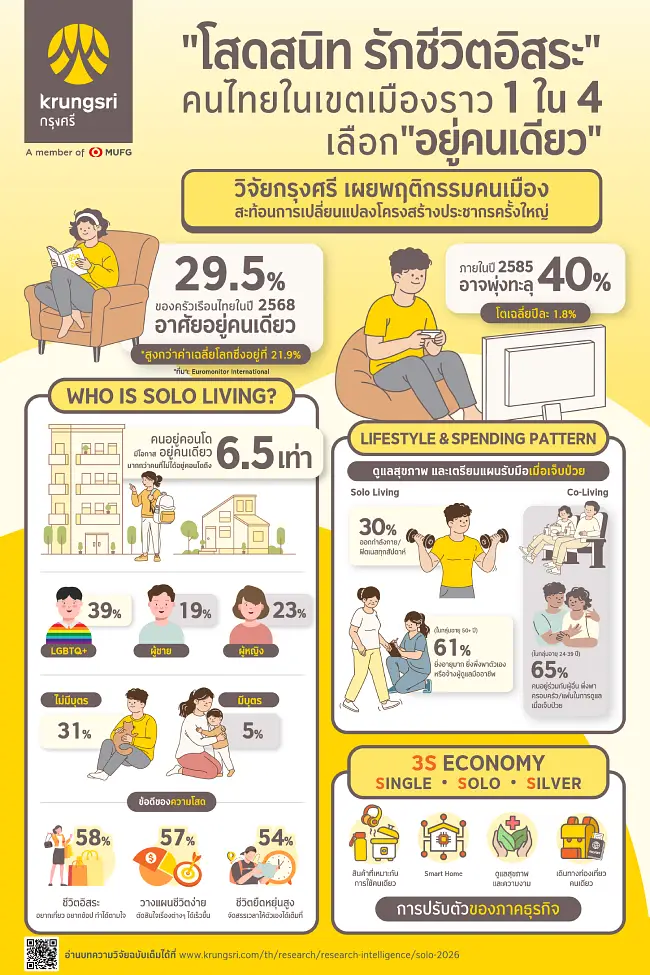
According to 2025 data from Euromonitor International, 29.5% of Thai households are single-person households—well above the global average of 21.9%. If the current 1.8% annual growth trend continues, single-person households could exceed 40% of all households in Thailand by 2042. The survey highlights who is most likely to live alone: condominium residents are approximately 6.5 times more likely to live alone than those in other housing types; respondents without children live alone at a rate of 31%, compared with only 5% among those with children; and LGBTQ+ respondents reported the highest solo-living share at 39%, compared with 23% for women and 19% for men. Respondents across all relationship statuses also broadly recognized the advantages of singlehood. When asked about the benefits of being single, 58% cited freedom—the ability to eat, travel, and shop on their own terms; 57% said life planning becomes easier; and 54% valued greater flexibility and control over their time. Only 1% saw no advantages at all.

Living alone vs co-living
Nearly one in four respondents said they live alone, and nearly half of this group reside in condominiums or apartments. Among those who are single and live alone, one in ten owns their residence. By contrast, around three-quarters of those who live with others reside in detached houses or townhouses. Within the co-living group, 49% live with parents or older relatives, 41% with a partner or spouse, and 10% with siblings, extended family members, friends, or children. Relationship status differs sharply between the two groups:
  • Solo-living group: 75% single; 16% in a relationship but not married; married and widowed/divorced at roughly 4–5% each.
  • Co-living group: 48% married; 30% single; 18% in a relationship; 4% widowed/divorced.

The data suggests that today's solo living is closely associated with single status, while most married respondents continue to live with a partner or family in line with traditional arrangements.

Living alone now ≠ living alone forever
Although 73% of respondents believe that at some point they will live alone and rely on themselves, that outlook is not primarily shaped by their current living arrangement. Instead, age, gender, relationship status, and whether they have children are the bigger drivers. The older the respondent, the more clearly they foresee living alone at some point. LGBTQ+ respondents were 2.8 times more likely than men to share this view; women were 1.8 times more likely than men; singles were 1.9 times more likely than those who are partnered or married; and those without children were 1.9 times more likely than those with children. In short, "living alone today" and "expecting to live alone in the future" are not the same thing. The latter is more closely linked to life stage, gender identity, and family path than to one's current living arrangement.

The solo lifestyle: self-reward, health, and long-term planning
Respondents who are single or live alone are more likely to invest in themselves, particularly in self-care and health. Notably, 30% of solo-living respondents exercise or go to the gym on a weekly basis significantly higher than the 25% observed among those who live with others—suggesting that solo living may allow for greater schedule flexibility and personal discipline. When asked how they would prepare for solo living in the future, 62% named maintaining physical and mental health as their top priority, followed by housing (19%), knowledge development (14%), and building social connections (5%).

A clear pattern also emerges around care preferences in the event of serious illness. Among solo-living respondents, reliance on self or professional care increases with age. In the Silver Age (50+) cohort, 61% said they would care for themselves as much as possible or arrange for professional care; this share declines to 55% among the Golden Midlife group (aged 40–49) and 47% among the Career Builders (aged 24–39). The co-living group shows the opposite trend: the Career Builders are most likely to rely on relatives or partners (65%), followed by the Golden Midlife group (61%) and the Silver Age group (57%). In short, solo-living respondents grow more self-reliant with age, while co-living respondents are most dependent on others when young—with that reliance gradually easing over time.
 
'Single and Loving It

Krungsri Research concludes that the "Single Economy" is a structural demographic shift, not a passing trend. Solo-living and single consumers possess meaningful spending power and are willing to invest in a better quality of life. More than half of respondents expressed interest in financial products and services tailored to their lifestyle for example, savings accounts with long-term financial planning features, add-on care and nursing services during illness, premium dating-app memberships, and travel packages designed for solo travelers. For businesses, the mandate is clear: prepare for a 3S economy—Single, Solo, and Silver—by designing products and services that serve the needs of singles and solo residents, while addressing the realities of a society in which more people are likely to live alone.

"The Single Economy Survey" by Krungsri Research polled 2,202 urban respondents aged 24 and above via online questionnaire during November–December 2025. For more information, visit https://www.krungsri.com/th/research/research-intelligence/solo-2026
 
'Single and Loving It, Living Free': Krungsri Research Finds One in Four Urban Thais Live Alone, Spend Mainly on Themselves, and Plan for Long-Term Health
PDF
Press keyword to search