Singles Are Reshaping Thailand’s Consumer Economy Urban survey by Krungsri Research finds 41% identify as single; singles travel abroad and attend more concerts than families; 4 in 10 women do not plan to have children

Singles Are Reshaping Thailand’s Consumer Economy

20 May 2026

Bangkok (20 May 2026) – The traditional image of a “father–mother–child” household as a life goal is quietly but powerfully evolving in Thailand. New findings from Krungsri Research show that “singles” now constitute the largest group out of a total of 2,202 individuals among urban Thais aged 24 and above, while their choices are giving rise to a consumer and lifestyle economy that businesses can no longer afford to overlook.

Why people are single: open to relationships, not rejecting love
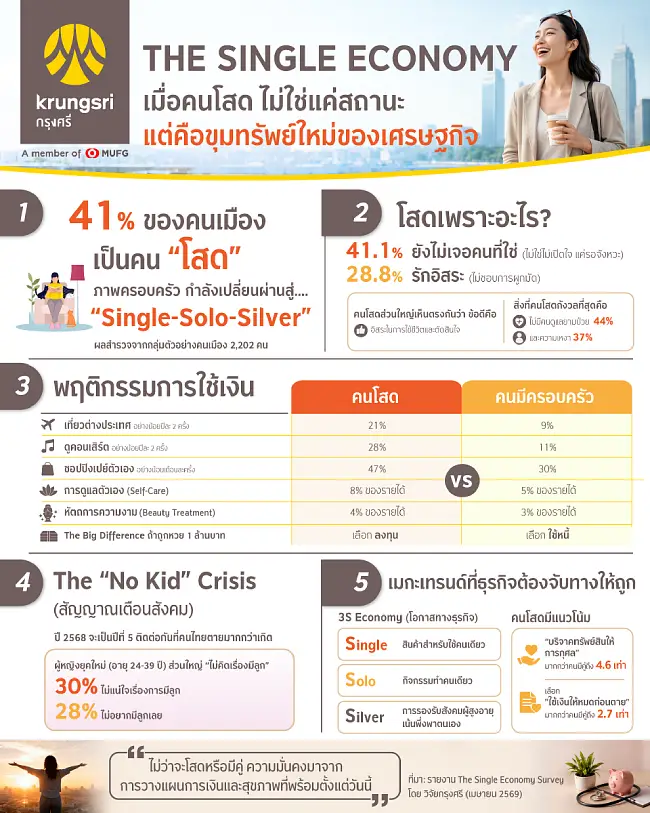
Among respondents, 41% identified as single. Of these, 41.1% said they “haven’t yet found the right person,” suggesting that most singles remain open to relationships. Another 28.8% said they choose to be single because they “value independence (prefer no tie).” When asked about the benefits of being single, respondents across all relationship statuses converged on similar views: greater freedom to live as one chooses, easier planning and decision-making, and more control over one’s time. Only 1% saw no advantages at all. Singles’ top concerns, however, centered on having no one to care for them when sick (44%), lacking a personal confidant (37%), and loneliness (33%). More than one in five also cited the absence of everyday care and companionship as a drawback.

How singles spend differently from families
The survey reveals a consistent pattern: singles spend more on themselves—on experiences, health, and personal enjoyment.
  • International travel: 21% of singles traveled abroad at least twice a year, compared with 9% of those with families.
  • Concerts: 28% of singles attended concerts at least twice a year, which is 2.7 times the rate among those with families.
  • Self-reward shopping: Nearly half of singles (47%) shopped for themselves at least monthly, which is twice the rate of those with families.
  • Health and beauty: Singles spent approximately 8% of income on fitness, supplements, and spa services (versus 5% among those with families), and around 4% on aesthetic procedures—averaging 20,156 baht per year, also above the family average.

Financial behavior also diverged notably: when presented with a hypothetical 1 million baht windfall, singles were more likely to invest, while those with families were more likely to pay down debt—reflecting different life responsibilities and priorities.
 
Singles Are Reshaping Thailand’s Consumer Economy

A societal signal: more women say they don’t plan to have children
Perhaps the survey’s most striking finding is that 38% of women said they do not plan to have children—significantly higher than men at 29%. Among respondents aged 24 – 39, a life stage typically associated with starting families, 32% said they do not plan to have children, 27% were undecided, and only 19% said they want children in the future. This reinforces Thailand’s low-birth trend, with 2025 marking the fifth consecutive year in which deaths outnumbered births.

From single to “3S”: what businesses should prepare for
Krungsri Research anticipates a full-fledged expansion of the “Single Economy”—a shift that will push businesses to design for a “3S” economy: Single–Solo–Silver. In practice, this means developing products and services not only for singles who may live alone, but also for an aging society that values mobility, independence, and self-reliance. More than half of respondents expressed interest in financial products tailored to single lifestyles—such as savings plans with built-in financial planning features, care services during illness, and travel packages designed for solo travelers. Sectors positioned for outsized growth include health and beauty services; easy-to-maintain housing with smart-home features; and estate and legacy management. Singles are also redefining what it means to have heirs. They are 4.6 times more likely than couples and families to donate assets to charity, and 2.7 times more likely to say they plan to “spend it all before passing”—signaling a worldview less anchored to bloodline inheritance.

Bottom line: single or coupled, planning is essential
Krungsri Research concludes that regardless of relationship status, the fundamentals remain the same: start financial planning, prioritize health maintenance, and build support networks—today. In a society where living alone is increasingly common, personal security will depend less on traditional family structures and more on individual preparedness for a changing social landscape.
 
The “Single Economy Survey” by Krungsri Research polled 2,202 urban respondents aged 24 and above via online questionnaire during November – December 2025.
 
Singles Are Reshaping Thailand’s Consumer Economy Urban survey by Krungsri Research finds 41% identify as single; singles travel abroad and attend more concerts than families; 4 in 10 women do not plan to have children
PDF
Press keyword to search